Money for nothing, checks for free?
The environmentalist:
Million Dollar Farm, Springtown Road.
At the last town board meeting, there was a public hearing to discuss the proposed conservation easement for 300 Springtown Road, also known as “Million Dollar Farm”. The name “Million Dollar Farm” has nothing to do with the property’s value. Back in the 1940’s this farm was heavily invested in (reportedly as much as $1 Million Dollars) and the farm was described “an outstanding example of Dairy farming at it’s best…Many visitors come to see the accredited herd of Holstein cows which are housed in the best sanitary buildings in Ulster County.” The name has stuck with it ever since.
The reason everyone is talking about Million Dollar Farm today has nothing to do with farming but environmental preservation.
After a long period of consideration and $28,000 dollars in legal fees, consultants and advisory groups, the property at 300 Springtown Road is being considered for a payment from the town’s Community Preservation Fund. If you remember, back in 2020/2021, the town decided to put a tax on all property sales of 1.5% and this money would be placed into a fund that could be used to “support the conservation of important town assets such as clean water, working farms, natural areas, and historic sites.”
To date the Community Preservation Fund has recently spent $844,500 to purchase and easement on the Humpo Marshlands and just this week is hoping to spend another $300,000 to purchase a conservation easement on the “Million Dollar Farm” property. It is not clear where the value for Million Dollar Farm comes from but at least for the Humpo Marsh this represented 61% of the appraised value.
What is a Conservation Easement?
A conservation easement is legal agreement that protects land from development and subdivision. Such an agreement is brokered with the partnership of third party environmental organizations (in the case of New Paltz this is normally, Open Space Institute, Wallkill Valley Land Trust or Mohonk Preserve— sometimes all three!) who will manage and monitor the easement agreement. The landowner retains ownership of the land and may pass on or even sell the land, although the terms of the easement must be adhered to by future owners.
Normally, these conservation easements are applied to lands that are in danger of development, and these funds are used to maintain the aesthetic, natural and historic character of New Paltz. For example the same fund and mechanism was used to preserve the land that now provides the “river to ridge” trail that many of us enjoy. There is obvious benefit here, as no-one would have wanted a sub-division of houses or a commercial development on the ‘river to ridge’ site as it is fundamental to the viewshed from the town to the ridge. It is also something that the whole town can, and do, enjoy.
What’s different about Million Dollar Farm?
The biggest difference between Million Dollar Farm and past purchases from the Community Preservation Fund is that the land of Million Dollar farm is not going to allow public access, because it is a working farm but more importantly it is not and will never be at risk of development. The cash payment of $300,000 to the owners, is a payment that is meant to preserve the land from development but the majority of the land is already protected by our wetland laws and our zoning regulations because almost all of it falls within the flood plain.
Already Protected!
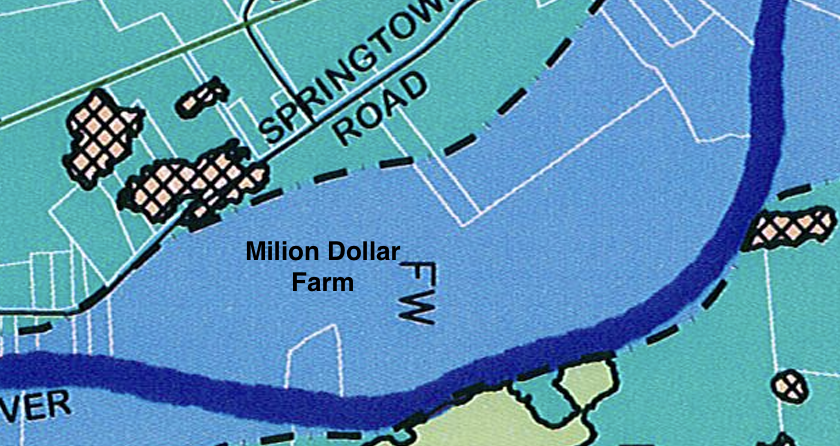
Light blue area is the Floodway District (FW) and the light green/blue areas are the Flood Fringe district
As you can see from the map above, the property that the town is paying $300,000 to protect is 90% within the Floodway and the remainder is within the Flood Fringe District.
Because these areas are part of our designated wetland and watercourse protection laws,there are already restrictions on:
Any form of mining, dredging or excavation and any grading or removal of soil, mud, sand, gravel, peat, silt or any other earth material from any regulated area, either directly or indirectly;
Any form of dumping, filling or depositing of any soil, stones, sand, gravel, mud, rubbish or fill of any kind in any regulated area, either directly or indirectly;
Erecting or constructing any structure, as defined in § 139-4 of this chapter, including those for which a building permit is typically issued (Refer to § 140-51.1 of Chapter 140, Zoning, of the Code of the Town of New Paltz.);
Placing any other obstructions within any regulated area, channelization or berming, as defined in § 139-4 of this chapter, whether or not the same affect the ebb and flow of water;
The introduction or storage of any substance, sewage effluent, the runoff of pesticides, or the disposal of toxic material, including chemicals, dyes, fertilizers or other organic materials, fuels, herbicides; pesticides, de-icing materials, or similar materials in any regulated area, if such materials are likely to cause the pollution of waters, except as provided in § 139-10K and where necessary for the public health, safety, and well-being of persons and property therein;
Draining or ditching within any regulated area;
Introducing any influents of high thermal content, such that the same are capable of causing deleterious ecological effects on any regulated area;
Installing septic disposal systems or swimming pool drainage systems or installing any pipe or other conduit for the same;
Withdrawing, diverting, detaining or retaining groundwater or surface water in excess of 2,500 gallons per day for more than seven days in the course of one year, which may cause an increase or decrease in the flow, velocity or volume of water (excluding the natural seasonal fluctuations of the subject watercourse or waterbody);
Clearing, as defined in § 139-4 of this chapter, within any regulated area, except routine maintenance or landscaping, as defined in § 139-4 of this chapter. Any activity regulated pursuant to Chapter 130, Tree Conservation, of the Code of the Town of New Paltz shall be regulated under this chapter as well if such activity occurs in a regulated area;
Except as lawfully permitted pursuant to ECL § 11-0505, displacement or destruction of that proportion of beaver lodges and beaver dams that would result in deleterious changes to the hydrology of wetlands, watercourses and beaver impoundments and/or negative impacts to wetland vegetation, flora and fauna, except in cases in which beaver impoundments are impacting or threatening to impact existing structures, roads, and driveways. Nonlethal approaches to beavers should be encouraged as the preferred solution, but this chapter shall not supersede NYSDEC jurisdiction over beaver trapping permits;
Any other activity that is determined by the Wetlands Inspector, with concurrence by the Planning Board, to have the potential for substantial adverse effects on the regulated areas.
Generally within the zoning laws of New Paltz, it is understood that New residential or commercial buildings along the river in the Floodway are prohibited.
So what do these town funds achieve for residents?
Nothing,
The construction of new residential and commercial buildings is already prohibited in the Floodway and the wetlands protections ensure there is no other activities that could damage the land. So what is the town board paying $300,000 for? This might be worth it if this area could include public access, because this is a gorgeous parcel of land along the Wallkill that has beautiful views up to the ridge. However, the agreement the town board came to with the landowners was that public access was not a necessary part of the agreement.
Although the use of the Community Preservation Fund is restricted in how and where the funds can be used, this is still tax payers money. This fund was financed with a tax on real estate transactions that people who moved to the area had to pay (a factor that increases the problem of affordable housing, not improves it). The process used to identify potential properties for conservation includes a lot of evaluation of the scenic, natural and aesthetic of the property, but does not at any point include a legal review of the protections already in place and the likelihood of development.